

Smart SPDs™ Technology: How Microsphere Design Shapes Modern Collagen Biostimulation
The next generation of aesthetic biostimulation is increasingly focused on material science, particle design and controlled tissue response.
At the centre of this development are microspheres: tiny particles whose size, shape, surface characteristics and degradation behaviour can influence how a collagen-stimulating material interacts with surrounding tissue.
Smart SPDs™ Technology is designed around this principle, featuring 30 μm microspheres and a biodegradable polymer platform intended to support controlled collagen stimulation.
But what exactly is a microsphere, and why does particle size matter?
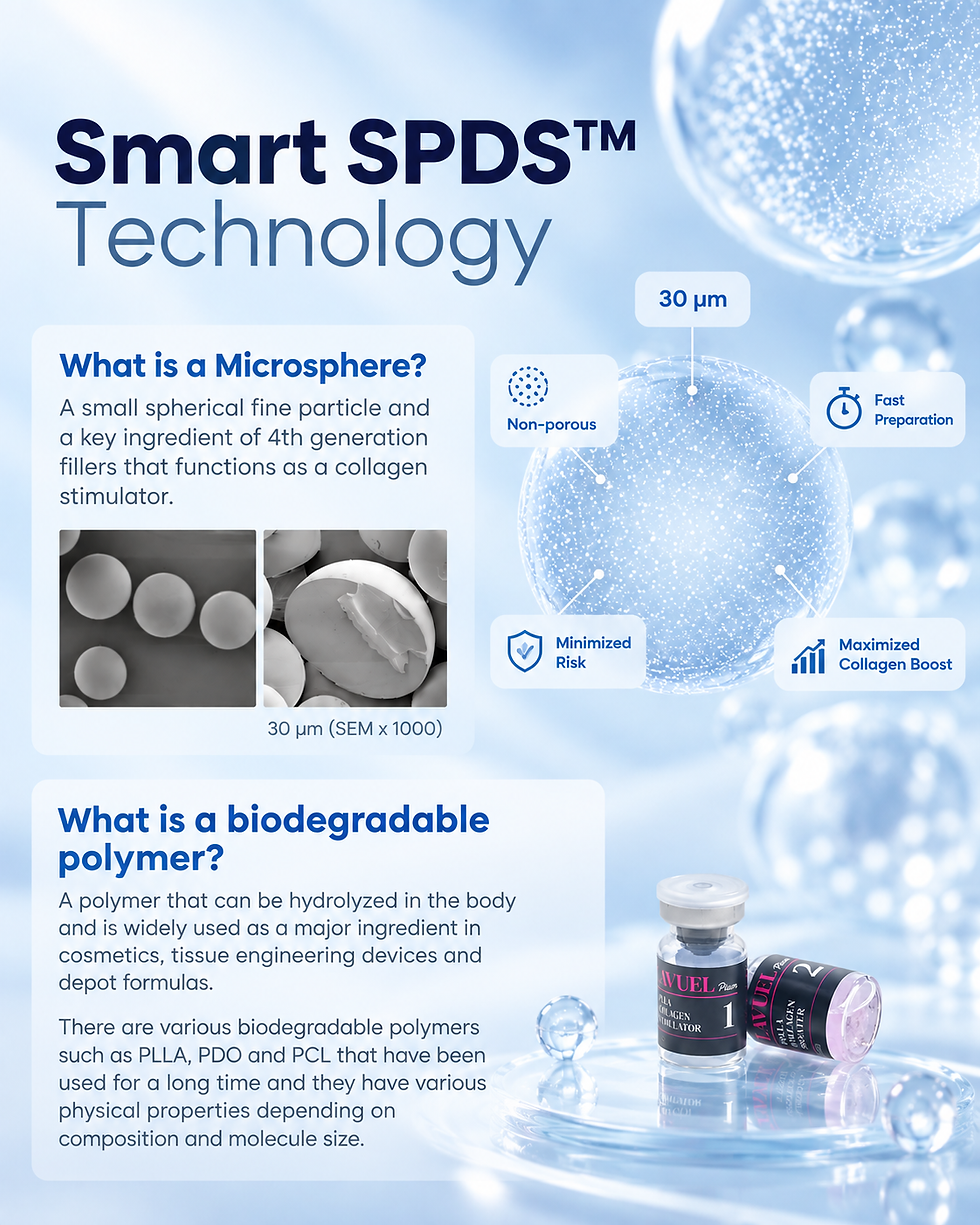
What Is a Microsphere?
A microsphere is a small spherical particle measured in micrometres (μm). In collagen-biostimulating materials, microspheres can act as the structural component responsible for triggering a biological response that supports new collagen formation.
Unlike conventional approaches that primarily focus on replacing lost volume, collagen biostimulators are designed to encourage the body’s own tissue-remodelling processes.
Research has shown that biodegradable polymer-based microspheres, including PLLA, PDLLA and PCL, can interact with surrounding tissue and stimulate fibroblast activity and extracellular matrix remodelling.
Why 30 μm?
Particle size is an important consideration when designing microsphere-based biomaterials.
The image above presents Smart SPDs™ Technology with 30 μm microspheres, highlighting:
30 μm particle size
Spherical particle structure
Non-porous characteristics
Controlled particle design
Collagen-stimulating potential
The physical characteristics of polymer particles—including particle size, shape and surface structure—can influence their biological behaviour and degradation profile.
This is why microsphere engineering is more than simply choosing a polymer. The structure of the particle matters.

Understanding PDLLA as a Biodegradable Polymer
PDLLA stands for poly-D,L-lactic acid, a biodegradable and biocompatible polymer that has attracted growing interest in dermatology and regenerative aesthetic applications.
As a biodegradable material, PDLLA can gradually break down through hydrolysis rather than remaining permanently in tissue. Research has explored PDLLA for applications including soft-tissue augmentation, skin firmness, wrinkle improvement and tissue regeneration.
This biodegradability is one reason biodegradable polymers have become important in modern collagen-biostimulating technologies.
Other biodegradable polymers used in aesthetic and biomedical applications include:
PLLA — Poly-L-lactic acid
PDLLA — Poly-D,L-lactic acid
PCL — Polycaprolactone
PDO — Polydioxanone
Each polymer has different physical and degradation characteristics, meaning that material selection can influence the overall behaviour of a biostimulating system.
From Microsphere to Collagen: How Biostimulation Works
Collagen biostimulators work through a biological process rather than simply acting as a passive volume replacement.
After placement within the target tissue, biodegradable polymer particles can interact with the surrounding biological environment. This can involve a regulated tissue response, followed by fibroblast activity and extracellular matrix remodelling.
Recent reviews describe PLLA and PDLLA as materials capable of supporting a controlled biological response associated with collagen and elastin production.
The overall concept can be simplified as:
Microsphere design → tissue interaction → fibroblast response → collagen formation → gradual tissue remodelling
This gradual mechanism is one of the defining characteristics of collagen biostimulation.
Why Uniformity Matters in Microsphere Technology
A sophisticated collagen-biostimulating system requires more than a biodegradable polymer.
Particle uniformity, morphology and surface properties can all contribute to the behaviour of microspheres within tissue.
Research into PLA-based collagen biostimulators has highlighted the importance of physicochemical characteristics such as particle size, shape, surface texture and hydrophilicity when considering biological activity.
For this reason, a precisely engineered microsphere platform can provide manufacturers and practitioners with greater control over the intended material characteristics.
Smart SPDs™ Technology highlights this concept through its 30 μm microsphere design, bringing particle engineering into focus as an important part of modern collagen-biostimulating technology.
Smart SPDs™ Technology: Designed Around Particle Science
Smart SPDs™ Technology combines the concept of microsphere engineering and biodegradable polymer science into one technology platform.
The key characteristics highlighted in the product concept include:
1. 30 μm Microspheres
A defined microsphere size provides a controlled starting point for material engineering.
2. Spherical Particle Structure
A consistent spherical morphology can contribute to predictable physical behaviour and particle distribution.
3. Non-Porous Design
The Smart SPDs™ concept highlights a non-porous microsphere structure as part of its particle design.
4. Biodegradable Polymer
PDLLA belongs to the family of biodegradable polymers studied extensively for biomedical and aesthetic applications.
5. Collagen Biostimulation
The ultimate concept is to support the body’s natural tissue-remodelling process and collagen production.
The Future of Collagen Biostimulation Is Getting Smaller
As aesthetic technology continues to evolve, attention is shifting from simply what material is used to how that material is engineered.
Microsphere size, morphology, surface characteristics, polymer composition and degradation behaviour all contribute to the performance profile of a collagen-biostimulating material.
Smart SPDs™ Technology reflects this evolution by focusing on 30 μm microsphere engineering and biodegradable polymer technology.
The future of collagen biostimulation may not simply be about adding more material—it may be about designing smarter particles with greater precision.

Conclusion
Smart SPDs™ Technology demonstrates how advanced microsphere engineering can become an important part of modern collagen-biostimulating solutions.
With its 30 μm microsphere design, spherical structure and biodegradable PDLLA polymer platform, the technology highlights a science-driven approach to tissue remodelling and collagen stimulation.
As research continues to explore the relationship between particle structure and biological response, microsphere engineering will remain an important area of innovation in aesthetic and regenerative medicine.


Comments