

PDLLA + HA vs PLLA: What Does the Clinical Evidence Show?
In the evolving field of collagen-stimulating aesthetic treatments, PDLLA + HA and PLLA are two approaches that have attracted significant clinical interest. But how do they compare when it comes to improving nasolabial folds (NLF)?
A recent randomised split-face clinical study provides useful insight into this question.
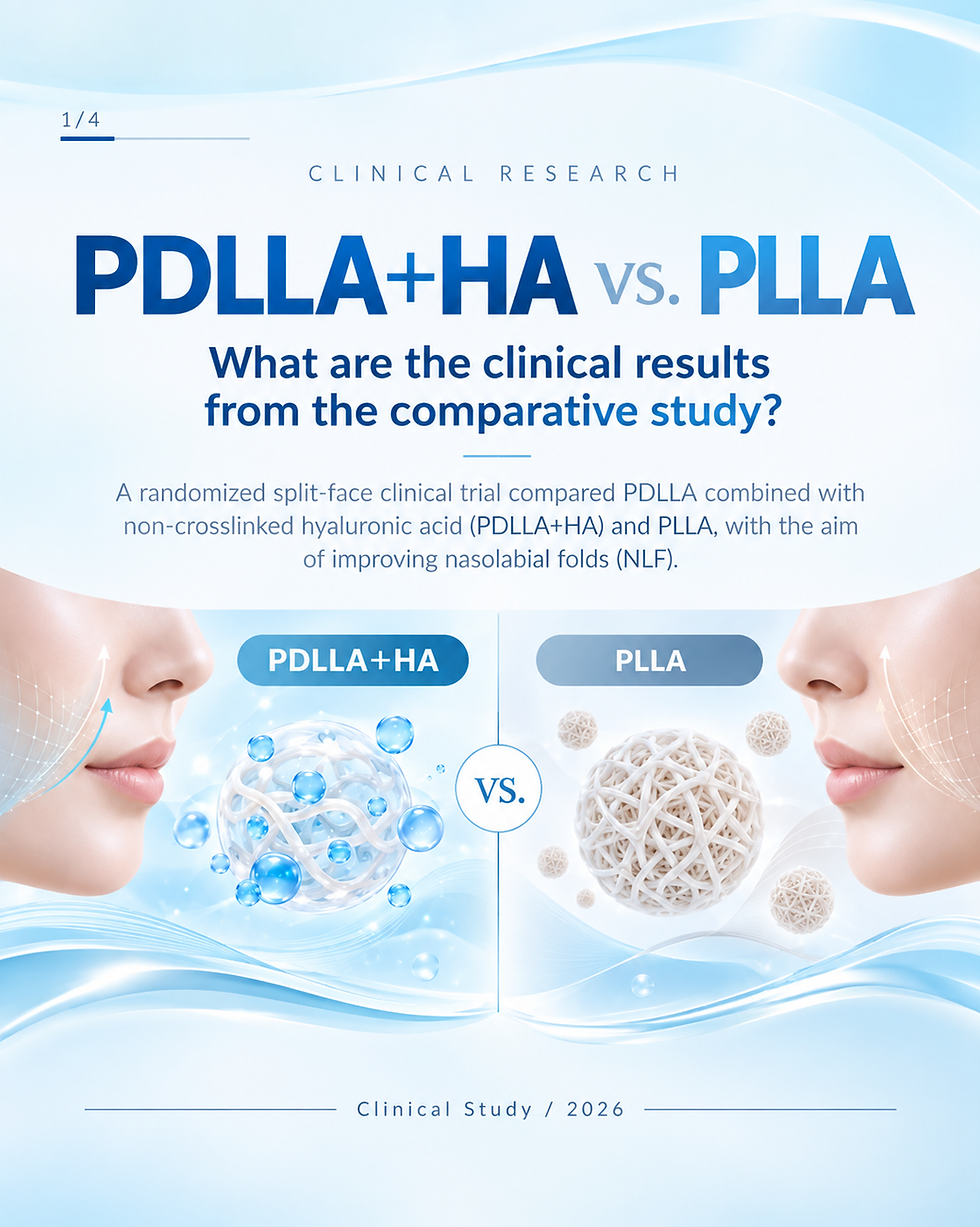
What Was the Study About?
The study evaluated the clinical outcomes of PDLLA combined with non-crosslinked hyaluronic acid (PDLLA + HA) compared with PLLA for the improvement of nasolabial fold severity.
A total of 33 subjects participated in the split-face study. Different products were used on each side of the face, allowing researchers to make a direct comparison within the same individual.
Participants received three treatments at four-week intervals:
Week 0 – First treatment
Week 4 – Second treatment
Week 8 – Third treatment
Nasolabial fold severity was assessed using the Wrinkle Severity Rating Scale (WSRS) at baseline and during follow-up.

Both Treatments Showed Significant Improvement
The results showed that both PDLLA + HA and PLLA produced a significant improvement in nasolabial fold severity compared with baseline.
The reported statistical significance was p < 0.001, indicating a statistically significant improvement over the observation period.
Interestingly, the degree of improvement was similar between the two treatment groups throughout the study.
The reported NLF severity scores decreased progressively from baseline through one, three and six months, demonstrating continued improvement during follow-up.
PDLLA + HA ≈ PLLA
The findings suggest that PDLLA + HA demonstrated non-inferiority compared with PLLA for improving nasolabial folds.
In simple terms, PDLLA + HA performed comparably to PLLA within the conditions of this study.
However, an important distinction should be made:
Non-inferiority does not mean superiority.
The study does not demonstrate that PDLLA + HA is better than PLLA. Rather, it indicates that the observed improvement with PDLLA + HA was not meaningfully worse than that achieved with PLLA according to the study’s non-inferiority framework.
Why Is This Comparison Interesting?
PDLLA and PLLA are both biodegradable polymer-based materials used in collagen-stimulating aesthetic approaches, but the addition of non-crosslinked HA introduces another component to the PDLLA + HA formulation.
This makes the comparison particularly relevant for understanding how different formulation strategies may perform clinically.
The study’s split-face design is also useful because each participant received the different treatments on opposite sides of the face. This allows researchers to compare outcomes while reducing some of the variability between different individuals.

What Happened Over Six Months?
The study followed participants through Week 24, corresponding to approximately six months after the initial treatment.
The reported trend showed that NLF severity decreased in both groups:
Baseline → 1 month → 3 months → 6 months
Both treatment groups followed a similar trajectory, with continued improvement compared with baseline.
This highlights an important characteristic of collagen-stimulating treatments: clinical assessment may extend well beyond the initial treatment period, making longer-term follow-up important when evaluating treatment outcomes.
What Can We Take Away From the Study?
The key findings can be summarised as follows:
1. Both approaches demonstrated significant improvementPDLLA + HA and PLLA both improved nasolabial fold severity compared with baseline.
2. PDLLA + HA showed non-inferiority to PLLAWithin this clinical study, PDLLA + HA demonstrated a comparable level of improvement to PLLA.
3. Similar improvements were observed over the follow-up periodThe treatment groups showed a similar trend from baseline through six months.
4. Non-inferiority is not the same as superiorityThe findings should not be interpreted as evidence that PDLLA + HA is clinically superior to PLLA.
5. More research is still neededFurther studies are necessary to better understand long-term safety and outcomes.

An Important Limitation
The study evaluated a specific PDLLA + non-crosslinked HA product.
Therefore, its results should not automatically be generalised to every PDLLA product available on the market.
Product composition, particle characteristics, formulation, manufacturing processes, treatment protocols and study populations can all influence clinical outcomes.
Conclusion
The comparative clinical evidence provides an interesting perspective on PDLLA + HA versus PLLA.
Both treatments demonstrated significant improvement in nasolabial fold severity, while PDLLA + HA showed non-inferiority compared with PLLA during the study period.
Rather than suggesting that one material is universally superior, the findings reinforce the importance of evaluating specific formulations and clinical evidence when considering collagen-stimulating aesthetic treatments.
For clinicians and aesthetic professionals, understanding the evidence behind each formulation can help support more informed treatment decisions and patient discussions.
Clinical evidence should always be interpreted in the context of the specific product, treatment protocol, patient population and study design. This article is for educational purposes and does not replace professional medical advice.


Comments